Highlights from the Week's News
This Week in Water™ airs on community and public radio stations nationwide and is available on podcast networks. Want environmental news delivered to your inbox? Sign up for our newsletter.
A "Dangerous, Chilling Effect" on Coastal States?
August 16, 2026
Trump Administration Attacks California Coastal Protection Agency
A California agency has rejected an oil company’s plan to increase its production off the coast near Ventura County, but the state’s powers are under attack by the Trump administration. Since 1972, the federal Coastal Zone Management Act has given California, among other states, the ability to manage shorelines, including the right to review and reject projects in federal waters.
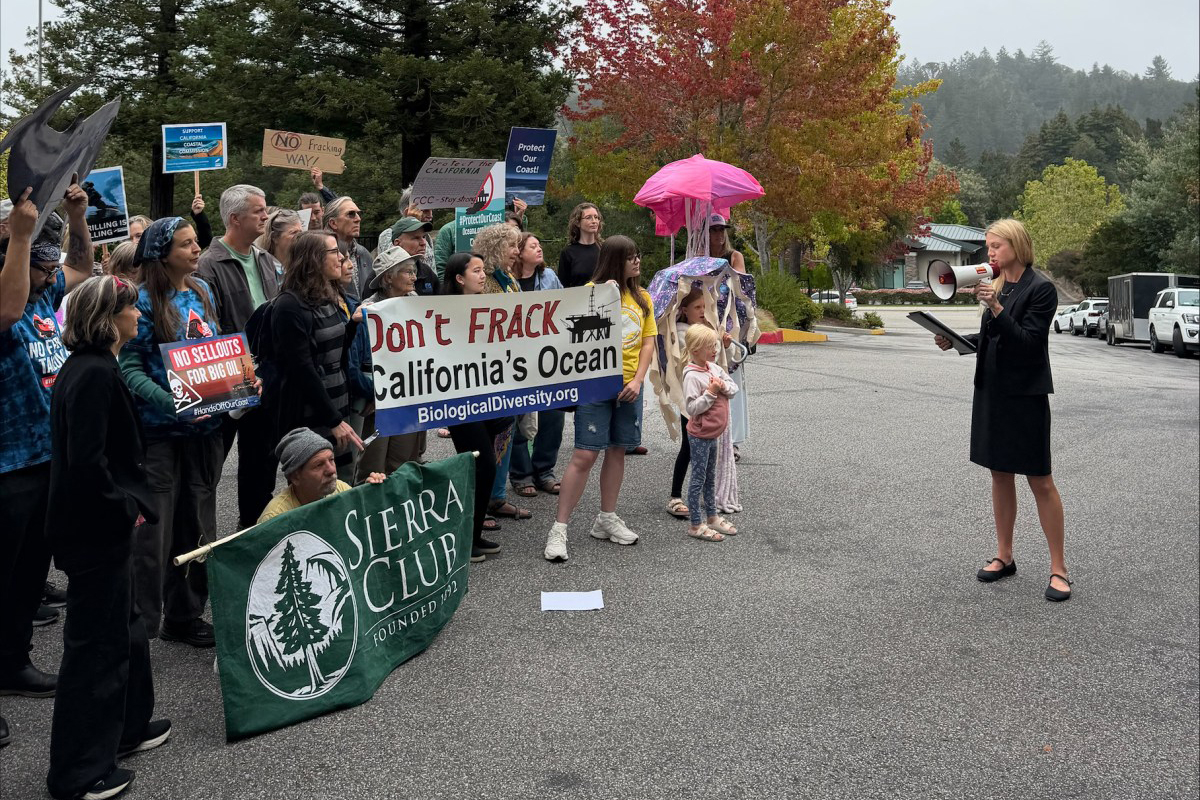
Maggie Hall, deputy chief counsel at the Environmental Defense Center, rallies attendees outside of a California Coastal Commission meeting in Santa Cruz against a fracking project near Ventura. | Photo courtesy Maggie Hall/Environmental Defense Center
The energy company DCOR LLC wants to increase its production by almost four times, from 1,100 barrels to 4,000 barrels per day, using a process that would inject seawater mixed with chemicals into 16 existing wells that fracture rock below the ocean floor. Sand or ceramic spheres would then be pushed into the fractures to keep them open, allowing oil and gas to flow.
The California Coastal Commission unanimously voted to object to the increased oil production plan after staff reported that it risked an oil spill in unique and ecologically rich waters, which would be difficult to contain. The commission protects the coast by regulating sustainable development using science, education, and public participation. An oil spill in 1969 that polluted the beaches near Santa Barbara, not far from the current proposal, led to the first Earth Day and is considered to have been “the galvanizing moment” in the environmental movement.
The state’s objection to the project could be overridden by the federal government because it is in federal waters, and that override seems likely as the Trump administration is currently attacking the California Coastal Commission’s very existence. Secretary of Commerce, Howard Lutnick, said in a letter posted on Twitter/X that California has a long record of obstructing economic development.
Last week, hundreds of activists, lawmakers, and citizens went to a hearing in Santa Monica held by the National Oceanographic and Atmospheric Agency, which is reviewing the powers of the state’s Coastal Commission. The move by the administration against the California Coastal Commission is an attempt to “silence the voices of states and local governments,” Meg Caldwell told the Los Angeles Times. The former director of Stanford’s Environmental and Natural Resources Law Policy program added that the action would result in a “massive power grab” and have a “very dangerous, chilling effect on other coastal states.”
A “Cool Mix" Release Meant to Protect Native Fish Is Canceled
Record low snowpack last winter along with aridification have made water levels so low at the two main reservoirs on the Colorado River that officials have canceled a “cool mix” release meant to protect native fish.
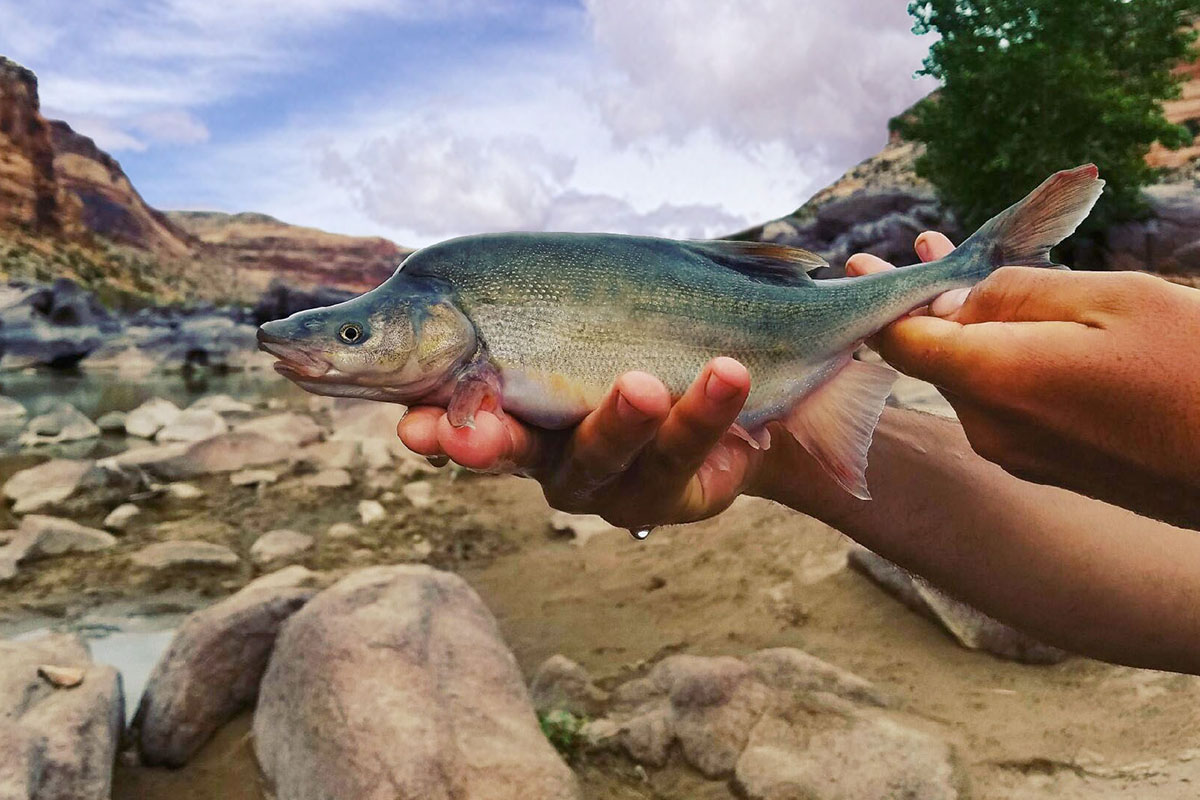
The Bureau of Reclamation has canceled the release of cool water from Glen Canyon Dam as it had done in 2024 and 2025 to protect the endangered humpback chub (Gila cypha), a native fish found only in the Colorado River Basin. | Credit: U.S. Fish and Wildlife Service
In 2024 and 2025, the Bureau of Reclamation opened outlets at the bottom of Glen Canyon Dam, in part to control smallmouth bass that thrive in warm water. Despite their name, the fish can open their mouths wide to feed on native humpback chub (Gila cypha), decimating their population. The humpback chub is native to the river and evolved three to five million years ago. Its body is specially formed to survive in fast and turbulent waters and the hump behind its head acts as a stabilizer that maintains its position.
Releasing cooler water from the depths of the reservoir to protect fish would hinder the ability of hydropower turbines to generate electricity. Because the water supply is limited and getting lower, hard decisions, like canceling the cool water release, must be made, John Berggren of the nonprofit Western Resource Advocates told the Associated Press. If the water were released to protect the fish, utilities that buy power generated by Glen Canyon Dam would have to seek alternative energy sources which could increase costs to their customers.
According to Science magazine, before Glen Canyon Dam was completed more than 60 years ago, floods occurred in the Grand Canyon every spring. To mimic those floods, in the past, the Bureau has released water to build up sandbars to provide habitat for fish—but those releases have also been canceled.
A Highly Toxic Pesticide Used Widely in the U.S. Is Being Banned in California
Paraquat dichloride, commonly known as “paraquat,” is one of the most widely used herbicides in the United States. It is so highly toxic—one small sip can be fatal—that it’s banned in 70 countries, including China, the UK, and the EU.

California’s Department of Pesticide Regulation (DPR) announced it will begin phasing out the herbicide paraquat, citing risks to human health and organisms.
While the U.S. Environmental Protection Agency prohibits its use around homes, schools, parks, and golf courses, the agency still allows its application in agriculture—and no state sprays more than California, where millions of pounds are used annually, primarily in the San Joaquin Valley.
But that’s about to change. Last week, California’s Department of Pesticide Regulation announced it will begin phasing out the weedkiller, citing its preliminary reports linking paraquat exposure to thyroid impacts and birth defects. They also found the pesticide may adversely affect other organisms, most significantly birds. Several studies have linked the weedkiller to Parkinson's disease.
Manufacturers had the option to submit new studies to address risks, but most opted to voluntarily withdraw their products from the market, including Sygenta, one of paraquat’s largest manufacturers, which said it was phasing out the product globally for commercial reasons.
The state’s decision was opposed by agricultural groups, such as the California Farm Bureau, which told the Los Angeles Times that the phase-out will present challenges for growers, leaving them fewer tools, higher costs, and less access to innovation. However, organizations working to fight Parkinson’s disease applauded the decision, saying science, advocacy, and public health policy are moving in the same direction.
California’s action follows Vermont’s first-in-the-nation ban and momentum is growing across the country. In June, Representatives Anna Paulina Luna, a Republican from Florida, and Chellie Pingree, a Democrat from Maine, introduced the Paraquat Prevention Act, which would require the EPA to cancel approvals for the herbicide.